Sometimes in academia, articles you have worked on over several years, suddenly are published at the same time. This spring was one such experience for me and my co-author Camilla Groth:
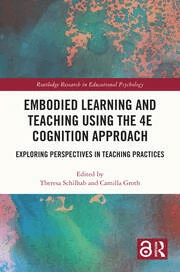
In May, a text we had worked on since 2018(!) expanding on the concept of embodied learning, titled “Thinking through hands in education” was published in the Routledge anthology Embodied Learning and Teaching using the 4E Cognition Approach: Exploring Perspectives in Teaching Practices, edited by Theresa Schilhab and Camilla herself. The abstract describes what we write about like this:
This chapter exemplifies and discusses the role of the body in teaching and learning. By the expression “thinking through hands”, we address the common misunderstanding that “thinking” is a process in our mind only and acknowledge that our mind does not have access to the world without our senses. We pay particular attention to the hands as they facilitate thinking as well as help externalise, extend, and distribute ideas out into the world. We refer to such thinking through hands as sense-making. We give examples of sense-making in craft practices and explain how material interaction develops skills and abilities that are transferable to other contexts and learning subjects. 4E theory sheds light on the role of the hands in thinking in other domains as well, and we end the chapter with recommendations for embodied teaching and learning.
The book and all the chapters are available open access and free of charge for everyone. Please read and let me know your thoughts if you have any!
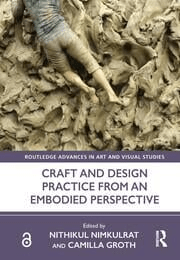
Then, in June, another chapter we had worked on for a good while was published. This chapter is called “Scaffolding visualization and mental rotation in designing and crafting“, and is published in the Routledge anthology Craft and Design Practice from an Embodied Perspective, edited by Nithikul Nimkulrat and Camilla (again). This abstract reads like this:
This chapter discusses visualization of shapes, specifically mental rotation, during design and craft practice and how this can be scaffolded with external aids. We present and discuss an autoethnographic case of a wood carver who temporarily lost parts of her mental visualization and rotation ability due to a brain tumour. We show how such a loss influenced the wood carver and how she used scaffolding techniques to support her lost ability. In this process, she also learnt that this ability is something that can be trained, thus we reflect on the implications of this for design and craft education.
This chapter and the anthology itself is also published Open Access, so it’s free for everyone to read online or to download and read later. I would love to hear your thoughts if you have any!
Both these chapters are written as a part of my “Making Matters?” project, that you may read more about under the heading “Research“.
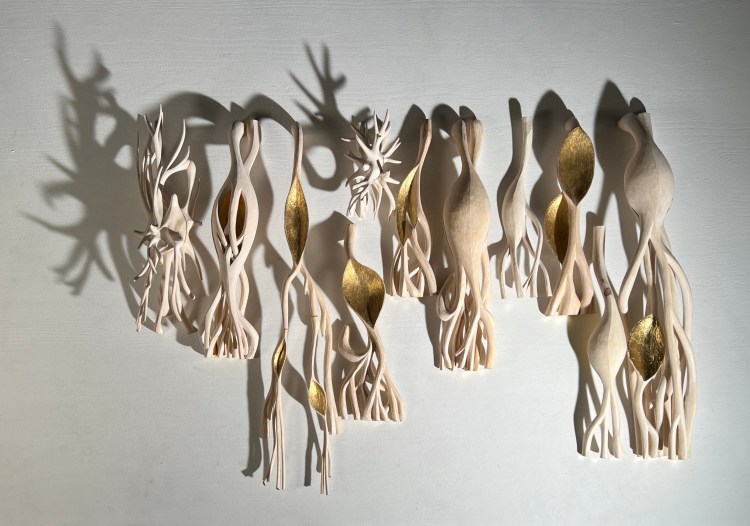
This academic year, I have also had several presentations about my artistic work and research. I continue working on my wooden neurons and astrocytes, and how they work together as “The forest in our brain”/”Hjerneskogen”. You might read more about it on this page, or on my practitioner presentation in the Creative Europe project “Craft Hub”
 Marte S. Gulliksen - Researcher, Artist, Teacher